Friday, February 4, 2011

Works By James Turrell

Celestial Events:


The Lights Inside:


My response to the site

I feel the Southbank center needs more coverage. This historical site is of great importance and I think the Southbank Center needs to be bigged up the way it was in 1951 for the festival.
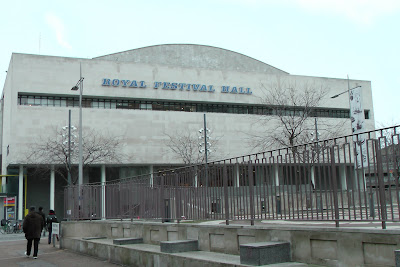
Royal Festival Hall, Queen Elizabeth Hall - are the venues where grand performances take place. Similarly the Hayward Gallery is an equally important exhibition center for Art. The mood and emotions of the interiors in these spaces needs to be felt out in the exterior. I feel it should be loud enough for people to celebrate and enjoy the progress of mankind in everyday life.


The plain concrete structures act as great spaces for projections and light shows and I will be looking at artists who work with the same.


Initial Response:


Before I start analysing the work from other artists I am conducting an in dept survey of the space I wish to study. I am looking at every single source of light located on the riverside terrace at the Southbank and will be making some detail drawings of the same to help with my progress for the chosen site.

Animated walk though of all the lights on the site:


Animated sketch of the position of each light on site:


Wednesday, February 2, 2011

Site Review

Site Survey:

The first impression I got of this place was that of being on the set of a sci-fi movie. The architecture is really futuristic and modern. The area gives u the feel of being in a concrete space spaceship that is floating on water.

In my personal journey through the whole site the most important part of this space was the festival terrace/ riverside terrace. This terrace is like the center piece of a jigsaw puzzle. It connects all the buildings that form the Southbank Center. Namely- Royal Festival Hall, Queen Elizabeth Hall, Hayward gallery, BFI and Purcell Room.


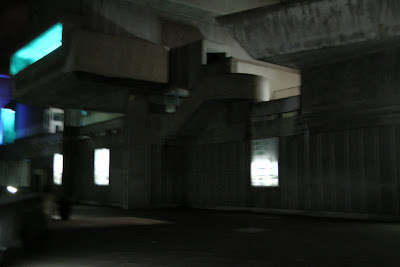
My second visit to this site was during the late evening. It was this time when I realised how deep the idea of this site being in space has been carried out. Odd lighting i.e. when on the terrace the only lights you have is the one's on the side wall of the terrace, then there was the bit that was reflected out through the glass windows in the restaurants and cafe's and finally the few huge spots and LED tray's next to the names of the buildings pointing towards the terrace. This then completely hide's the architectural beauty of the space.
Imagine a car coming towards you with its head lights on dim in a dark thick forest! The size of the vehicle would be impossible to guess in that kind of a situation.
Bearing in mind the above example the beauty of the Southbank architecture suddenly disappears after dusk due to the poor lighting conditions.


Returning to my research on expanded cinema I wanted to survey the terrace as if it was being watched by a moving CCTV since the idea of the watcher being watched was quiet intriguing for me. Adding my experiment with scratch film to the cctv footage gave it an interesting look generating a new outcome.

Scratch film:


CCTV Site Survey with Scratch Film Effect:


My research on CCTV footages from online resources:


Tuesday, February 1, 2011

Site Research


History Of The Site:

Southbank Centre is certainly more than the sum of its buildings – the Royal Festival Hall, Queen Elizabeth Hall, Purcell Room, Hayward Gallery. It stretches from the London Eye to BFI Southbank (formerly the National Film Theatre) and includes a flagpole, a book market, cafés and restaurants, fountains and free foyer entertainment. But, most importantly, it is home to memories.

Southbank center as it stands today grew out of the Festival of Britain’s flagship exhibition, held on the south bank of the Thames in 1951. At that time, shortly after the end of World War II, much of London was still in ruins and redevelopment was badly needed. The Festival was an attempt to give Britons a feeling of recovery and progress and to promote better-quality design in the rebuilding of British towns and cities following the war. The Festival also celebrated the centenary of the 1851 Great Exibition. It was the brainchild of Gerald Barry and the Labour Deputy Leader Herbert Morrison who described it as "a tonic for the nation".

After years of bombing and rationing, the South Bank Exhibition was an unprecedented extravaganza, filled with new technology, art, design and colour. Eight-and-a-half million people arrived by train, tram, bus, car and on foot to experience it.


1950’s

The Royal Festival Hall, designed and built within three years by Holland, Hannen & Cubitts is the only surviving building from the festival of London and had officially opened on 3 May 1951.


1960’s

From 1962 to 1965, the Royal Festival Hall was extended towards the river and Waterloo station and refurbished. The London County Council (later, Greater London Council) decided in 1955 to build a second concert hall and an art gallery on the eastern part of the South Bank site previously occupied by a lead works and shot tower (and which had been earmarked as a site for the National Theatre. The Queen Elizabeth Hall and Purcell Room were built alongside the Royal Festival Hall in 1967, and the Hayward opened in 1968.


Since then the site has undergone major redevelopments due to change in political power and has been subject to various plans for reconstruction.

(A Festival On The River: the story of southbank center - Charlotte Mullins)


Expanded Cinema -PART 2


17th -19th of April of 2009 -Expanded Cinema :

Activating the Space of Reception.

Concentrated around the Tate Modern, the long series of conferences programmed during these three days served to debate the concept of Expanded Cinema to engage in a dialog on their practices and their meaning. Multi screening, installations, performances, live-cinema and other cinematographic manifestations of heterogeneous nature accompanied the readings to discuss inheriting filmic perspective of the artistic context of end of the Sixties. It was Stan Vanderbeek who made the term famous, but Gene Youngblood indeed theorised it with visionary success in his letter of 1970 entitled “Expanded Cinema”.

The concept Expanded Cinema comes to define an eclectic field characterised by filmic and video works that break the traditional notion of the room of cinema, to investigate other ways of reception; extending the experience kinematics of the spectator towards new sensorial connections of unusual spatio-temporal entailments.


Works of Steve Farrer, Tamara Krikorian and Lis Rhodes were exhibited at this time at the tate. Their work was based on lights, projections and sound.


Monday, January 31, 2011

Expanded Cinema


"Expanded cinema identifies a film and video practice which activates the live context of watching, transforming cinema's historical and cultural architectures of reception into sites of cinematic experience that are heterogeneous, performative and non determined"

Expanded cinema was used by Stan Vanderbeek in the 1960's

A pioneer in the development of experimental film and live-action animation techniques, Stan Vanderbeek was a visonary of avant-garde and expanded cinema. Advocating a utopian fusion of art and technology, he produced theatrical, multimedia experiments that include projection systems, dancem planetarium events and the exploration of early computer graphics and image-processing systems.

Works:
Science Friction-
His early work (1955-1965) was based on cutting images from magazines and books thus creating dream-like pieces. He would animate paintings, drawings and collages thereby creating a random contrast in the piece of work.


Poem field -
Poem field is the name of a series of 8 computer-generated animations by Stan Vanderbeek and Ken Knowlton in 1964-1967. The animations were programmed in a Language called Beflix (short for "Bell Flicks"), which was developed by knowlton.


Other Examples of Expanded Cinema:

British experimental novelist, poet, critic, and filmmaker B.S. Johnson, author of Alberto Angelo (1964) and House Mother Normal (1971) made several films in his brief ten year career. Fat Man on a Beach, finished just before his suicide at age 40, starts with Johnson's unique brand of the absurd and comic, and ends with him walking directly into the sea:

“A simple but audacious idea was proposed: Johnson should revisit his beloved Lleyn penninsula [setting of Johnson's first novel, Travelling People (1963)] and he should make a film about it. The format would be quite straightforward: forty minutes of Johnson sitting on his favourite beach, Porth Ceriad, and talking directly to camera about anything that happened to come into his head" Jonathan Coe, Like a Fiery Elephant: The Story of B.S. Johnson


Life with Expanded Cinema:

BAFTA award winning sound editor, film and video maker, artist, writer and photographer, JOHN CRUMPTON on his blog gives a detailed account of how expanded cinema was a part of his life and explains the journey in depth.

http://www.johncrumpton.co.uk/page20.htm


After looking at the history and understanding the concept of expanded cinema I think I realise the potential of the same and would like use this in the near future.